Goa Gajah

Goa Gaja Tempel
Goa Gaja Tempel © Bali.info

Eines der interessantesten Reiseziele auf der Insel Bali ist die „Elefantenhöhle“ Goa Gajah. Sie heißt zwar tatsächlich so, man muss es dennoch in Anführungszeichen schreiben. Denn wahrscheinlich handelt es sich bei der Benennung der erst 1923 entdeckten Höhle um ein Missverständnis und sie hat nichts mit Elefanten zu tun.

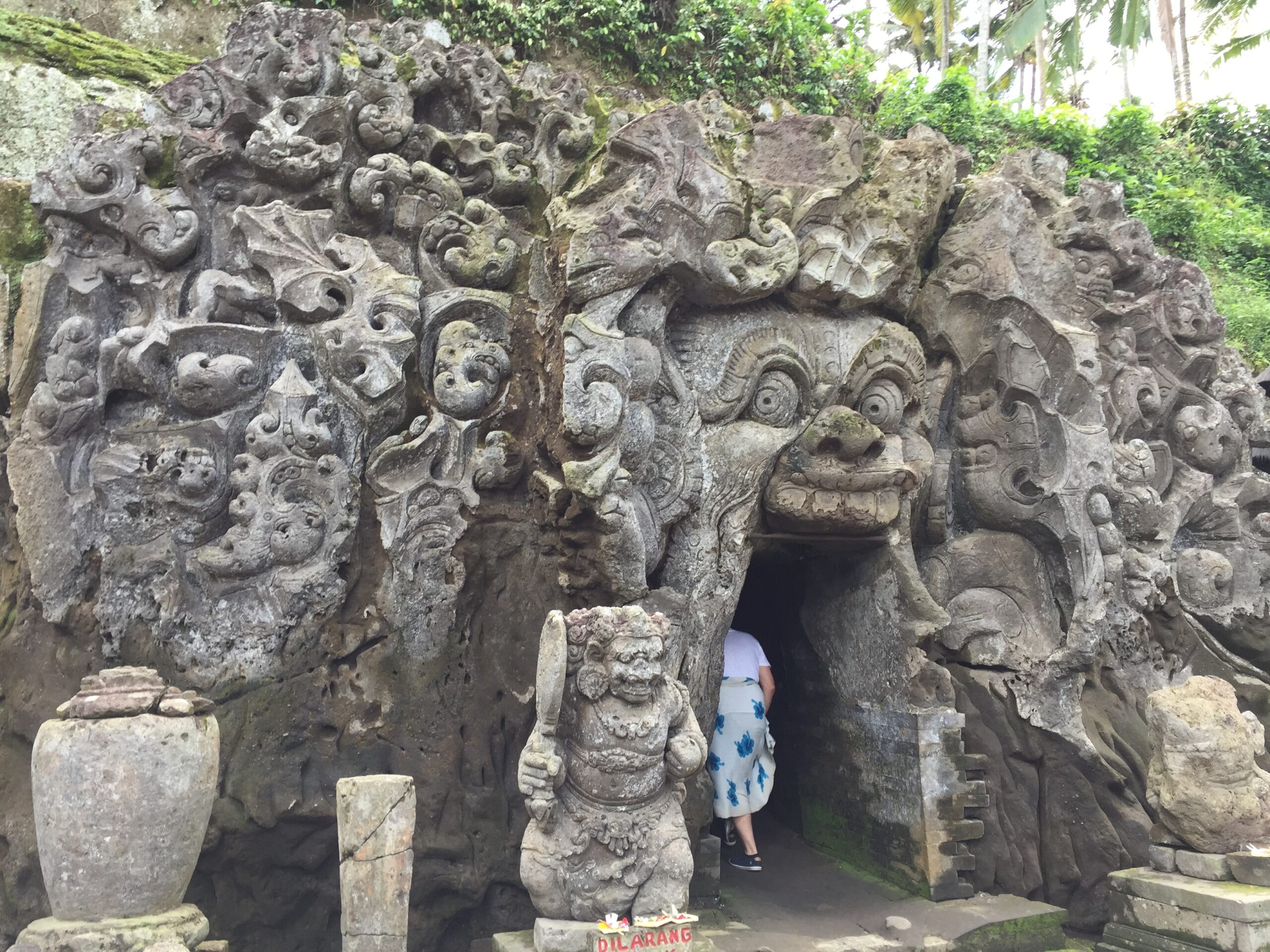
Nichtsdestoweniger ist sie mit ihrem riesigen Relief am Eingang und mit ihrer gesamten Konstruktion ein absolut spannendes Ereignis. Wo liegt die Elefantenhöhle, was macht sie aus und was sollte man sonst noch für einen Besuch wissen? Antworten auf diese Fragen gibt es in den folgenden Abschnitten.
Adresse und Eintritt für die Elefantenhöhle Goa Gajah

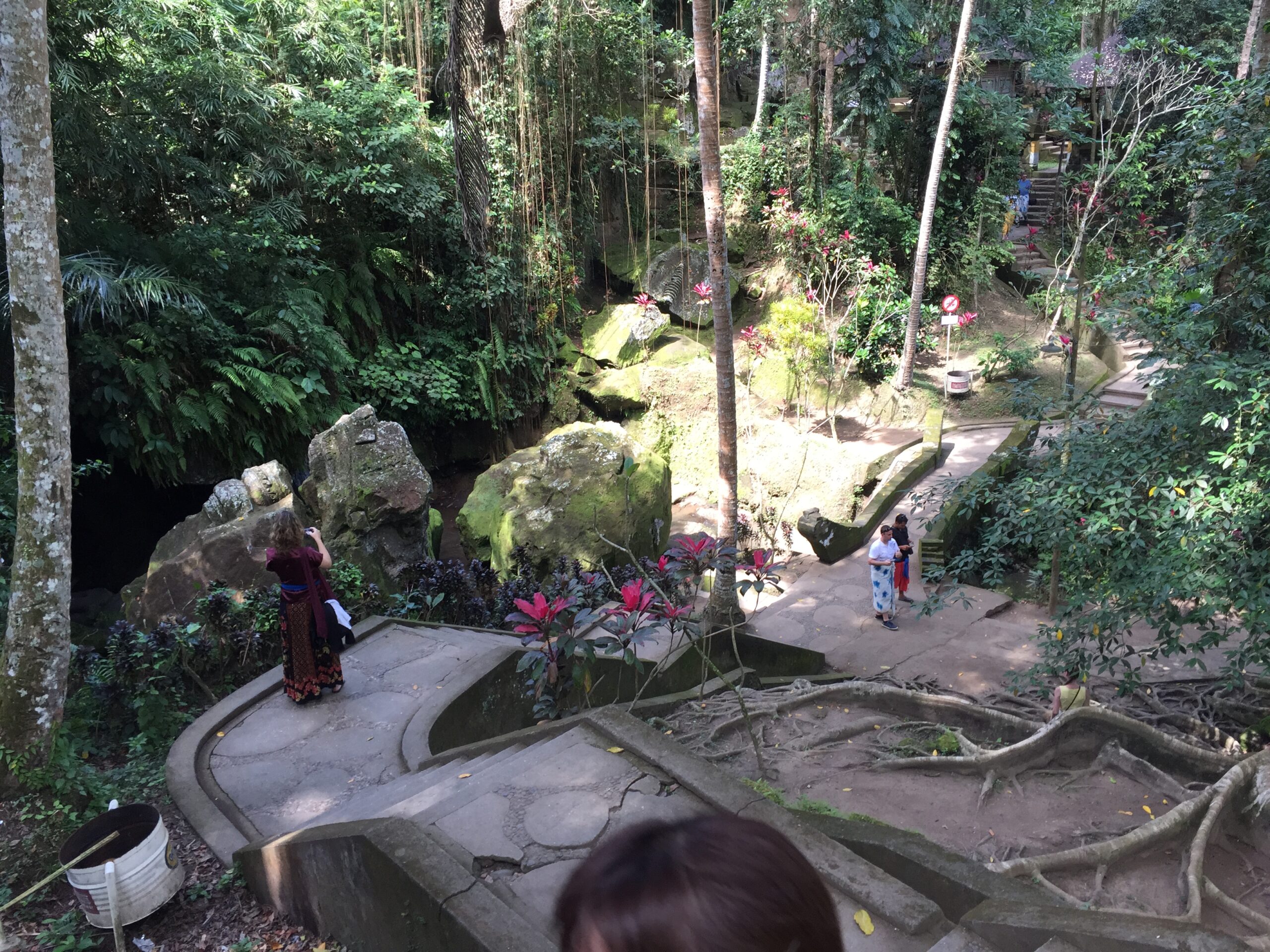
Eine klassische postalische Adresse besitzt diese Reisedestination nicht. Dies sind ihre Koordinaten: Süd 8°31’22.98 Ost 115°17’16.39. Damit befindet es sich nur etwa 5 Kilometer von der südöstlichen Küste Balis entfernt. Hotels und weitere Unterkünfte findet man in der größeren, naheliegenden Stadt Ubud in ausreichender Zahl. Parkplätze für Besucher sind direkt an der Höhle vorhanden. Im direkten Umfeld kann man sich sehr gut mit Snacks und Getränken versorgen.

Der Eintritt für Erwachsene betrug zuletzt 15.000 Rupiah, was etwas weniger als einem Euro entspricht. Für Besucher geöffnet ist die Elefantenhöhle Goa Gajah von 8 Uhr bis 18 Uhr.

Was ist die Goa Gajah nun tatsächlich?

Die Goa Gajah ist eine Höhle in der Nähe der Stadt Ubud auf der indonesischen Insel Bali. Konkret befindet sie sich beim Örtchen Bedulu. Sie wurde wahrscheinlich im 9. Jahrhundert errichtet und ist ein Heiligtum. Die genauen Ursprünge dieser erst heutzutage „Elefantenhöhle“ getauften Höhle sind unbekannt. Man nimmt an, dass sie vor allem als Ort des Gebetes und der spirituellen Meditation diente. Die gesamte Anlage besteht allerdings aus mehr als nur der Höhle, der Eingang von einem großen Relief verziert wird. Mehrere Quellbecken und Brunnen gehören auch dazu, die ebenso sehenswert sind wie die Höhle selbst, da auch sie von Statuen gesäumt werden. Und darüber hinaus sind sie eben auch kulturhistorisch wertvoll, so wertvoll, dass sie seit geraumer Zeit zum UNESCO-Weltkulturerbe zählen.

Nicht nur aus diesem Grund ist sie eines der touristischen Highlights auf Bali. Allerdings bedeutet das ebenso, dass es hier meist recht voll an interessierten Gästen ist. Abgeschiedenheit und Besinnlichkeit erlebt man hier heutzutage eher nicht mehr. Dennoch lohnt sich ein Besuch sehr. In ihrem Innern, hat man erst einmal den den Eingang bewachenden Dämon passiert, wartet sie mit allerlei Statuen auf, teilweise auf Altären drapiert.

Was erwartet die Besucher im Inneren der Elefantenhöhle?

Da wäre zunächst eine Statue des Elefantengotts Ganesh mit seinen vier Armen, der ein Sohn von Shiva ist, einer hinduistischen Gottheit. Weiter rechts stößt der Besucher auf drei Lingams, die die drei Erscheinungsformen von Shiva repräsentieren:

  • Brahma
  • Vishnu
  • Shiva

Eingefasst werden diese von zahlreichen Phallussymbolen, die hier als Wächter der Welten gelten.

Da es im Inneren der Elefantenhöhle recht dunkel ist, ist es ratsam, seinen Besuch mit einer Taschenlampe ausgerüstet zu absolvieren. Die ausgestellten Figuren bergen viele spannende Details, die der Aufmerksamkeit ohne ausreichende Beleuchtung wohl entgehen würden. Neben den genannten Statuen finden sich hier auch noch zahlreiche Darstellungen von altbalinesischen Dämonen, genauso aber auch mehrere Statuen von Buddha. Der Grundriss des Inneren der Elefantenhöhle ist T-förmig, wobei der Eingang exakt in Nord-Süd-Richtung ausgerichtet ist.

Was kann man in der Umgebung der Elefantenhöhle unternehmen?

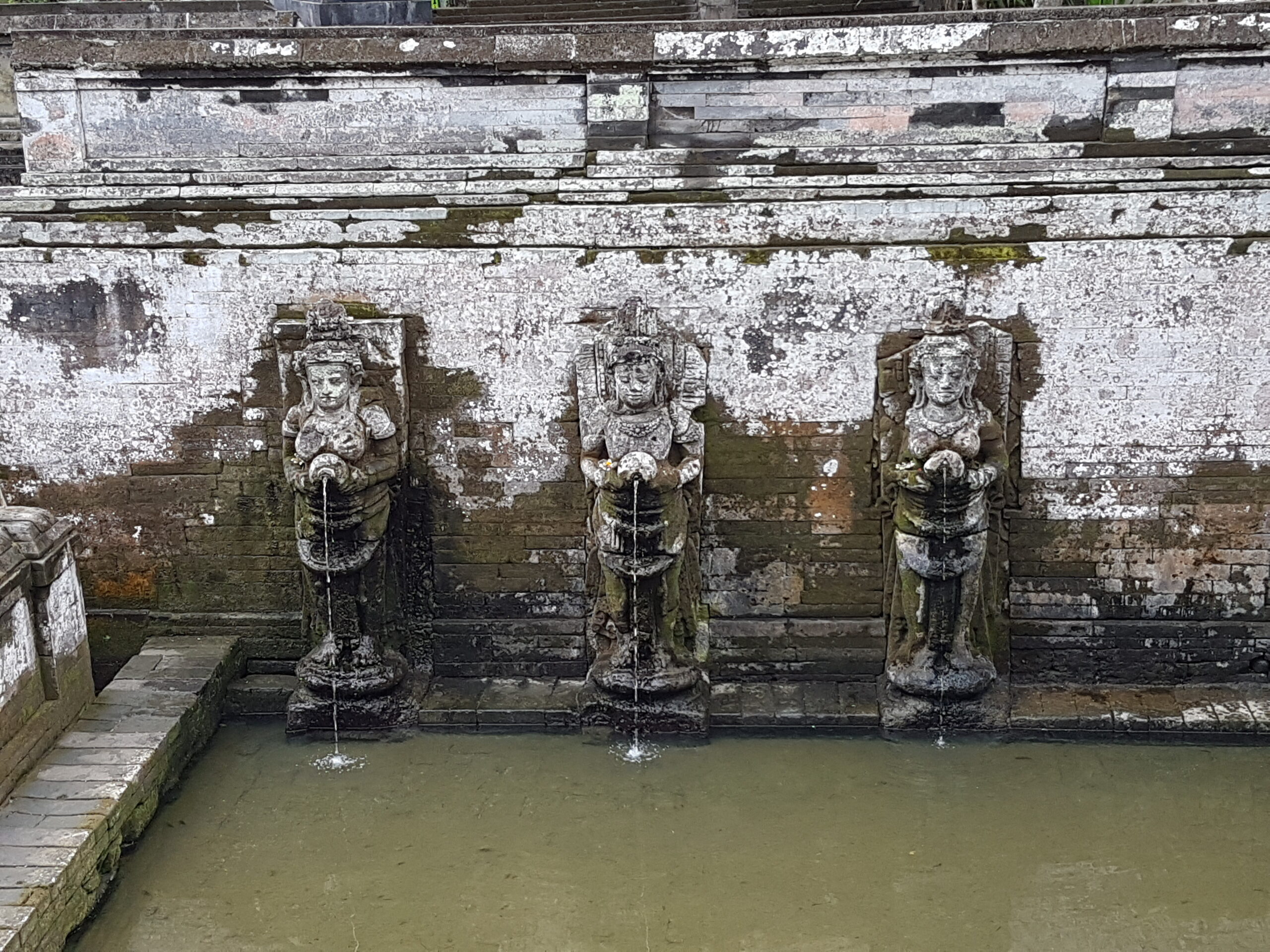
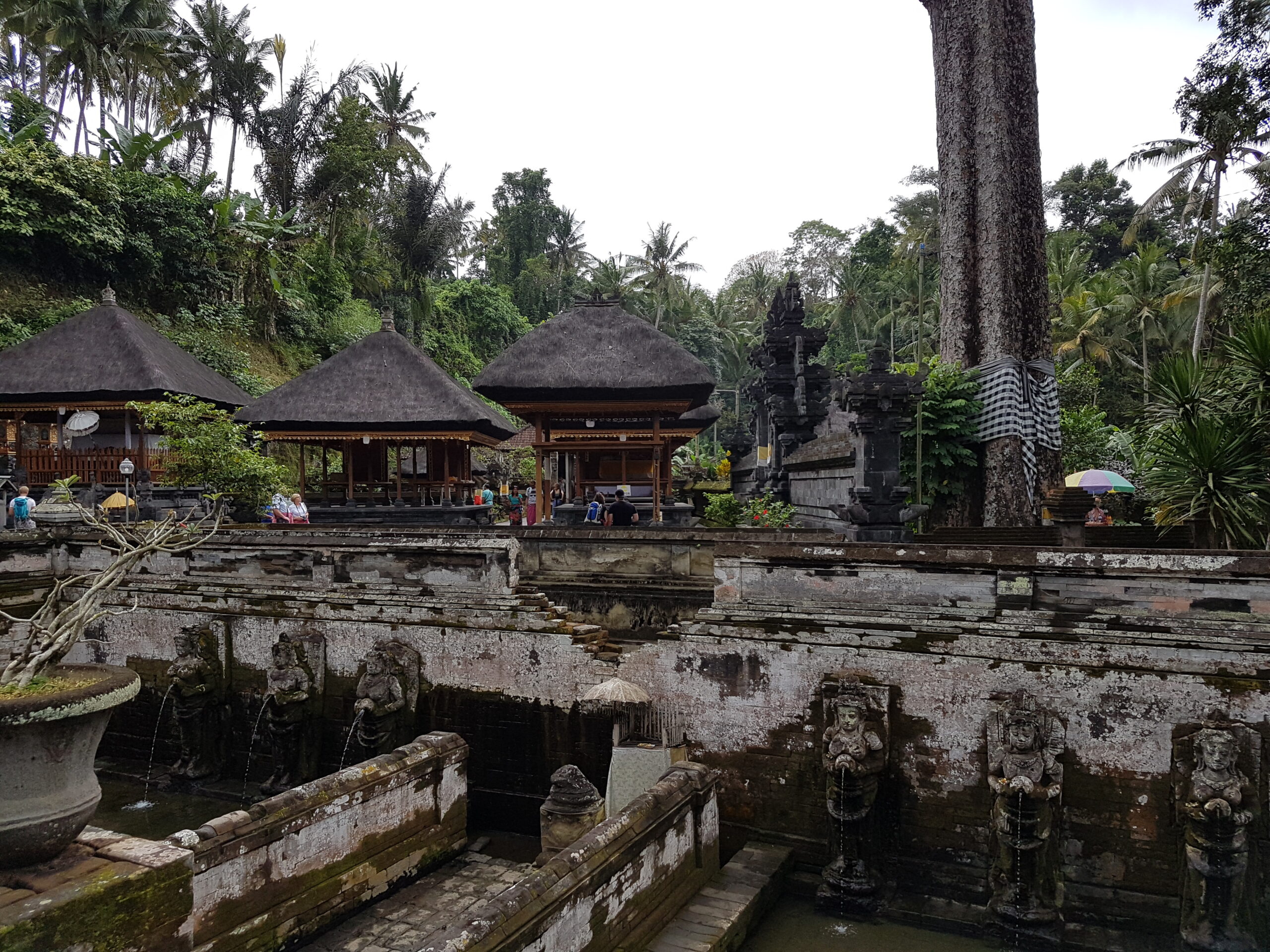
Nicht weit vor dem Eingang finden sich wie erwähnt jene drei Quellbecken, die man erst einige Zeit nach der Höhle selbst entdeckte. Diese dienten wohl der Entnahme von „heiligem“ Wasser. Die Becken sind mit sechs kunstvoll verzierten Quellnymphen aus Stein geschmückt und damit ebenfalls sehenswert, noch dazu eben auch ohne Hilfsmittel bei normalem Tageslicht.

Wer einigermaßen gut zu Fuß ist, kann sich auf eine Wanderung durch die naheliegenden Reisfelder machen. Durch diese hindurch führt ein kleiner Pfad zu Yeh Pelu, einem sogenannten Quellheiligtum. Es umfasst ein beinahe 30 Meter langes und 2 Meter hohes Relief, das Alltagsszenen aus der Zeit seiner Entstehung zeigt. Diese wird auf das 14. oder 15. Jahrhundert geschätzt, Genaueres ist dazu nicht bekannt. Welchen Zweck dieses Relief hatte, konnte bislang ebenfalls nicht erforscht werden.

Am ebenfalls in der Nähe befindlichen Fluss Petanu gibt es einige weitere Buddha-Statuen zu sehen. Manche Fachleute vermuten, dass hier einst ein buddhistisches Kloster existiert haben muss. Weitere Überreste davon hat man bislang allerdings nicht entdeckt.

Außerdem ganz in der Nähe liegt der Tempel Pura Taman, der wiederum seinerseits viel Interessantes zu bieten hat und vielleicht am selben Tag besichtigt werden kann. Die Größe einer Tempelanlage oder auch nur eines einzelnen Tempels erreicht die Elefantenhöhle nämlich trotz ihres hohen kulturellen Wertes nämlich bei Weitem nicht.

Trivia zur Elefantenhöhle

Zur Zeit der Entdeckung der Höhle durch niederländische Archäologen im Jahr 1923 gab es keine Elefanten auf Bali. Insofern ist die Titulierung wohl auf eine Fehlinterpretation der Darstellungen an ihrem Eingang zurückzuführen. Mittlerweile leben tatsächlich einige Elefanten auf Bali. Diese wurden aber aus touristischen Gründen extra dorthin verbracht, haben aber mit der eigentlichen Entstehungsgeschichte der Höhle nichts zu tun.

Bemerkenswert ist die Koexistenz von Statuen des Buddhismus und des Hinduismus an selber Stelle. Offenbar gab es früher eine solche in friedlicher Form, was andernorts eher selten durch ähnliche historische Konstellationen bestätigt wird.

Fazit zu einem Besuch der Elefantenhöhle Goa Gajah

Ein in der gesamten Region einzigartiges Bauwerk stellt die Elefantenhöhle Goa Gajah dar. Ein seltsamer Mix aus Statuen von Gottheiten des Hinduismus und Buddhismus sowie altbalinesischer Dämonen ergeben hier ein vielleicht weltweit einmaliges Ambiente, das nicht umsonst bei den Besuchern des Landes ein so beliebtes Reiseziel darstellt. Da es auch sehr gut zu erreichen ist, sollte man bei seinem Indonesien-Urlaub nicht auf einen Trip zu dieser Anlage verzichten.

Goa Gajah

Goa Gaja Tempel © Bali.info

One of the most interesting destinations on the island of Bali is the „elephant cave“ Goa Gajah. It is actually called that, but you still have to put it in quotation marks. Because probably the naming of the cave, discovered only in 1923, is a misunderstanding and has nothing to do with elephants.

Nevertheless, with its huge relief at the entrance and with its entire construction, it is an absolutely exciting event. Where is the elephant cave, what makes it tick and what else should you know for a visit? Answers to these questions are provided in the following sections.

Address and entrance fee for the elephant cave Goa Gajah

This travel destination does not have a classic postal address. These are its coordinates: South 8°31’22.98 East 115°17’16.39. Thus, it is located only about 5 kilometers from the southeastern coast of Bali. Hotels and other accommodation can be found in the larger, nearby town of Ubud in sufficient numbers. Parking for visitors is available directly at the cave. In the immediate vicinity you can get snacks and drinks very well.

Admission for adults was last 15,000 rupiah, which is slightly less than one euro. For visitors, the elephant cave Goa Gajah is open from 8 am to 6 pm.

So what is the Goa Gajah actually?

The Goa Gajah is a cave near the town of Ubud on the Indonesian island of Bali. Specifically, it is located at the village of Bedulu. It was probably built in the 9th century and is a sanctuary. The exact origins of this cave, only nowadays christened „Elephant’s Cave“, are unknown. It is believed that it served primarily as a place of prayer and spiritual meditation. However, the whole complex consists of more than just the cave, the entrance of which is decorated by a large relief. Several spring pools and fountains are also included, which are as worth seeing as the cave itself, as they are also lined with statues. And what’s more, they are also valuable in terms of cultural history, so valuable that for some time now they have been included in the UNESCO World Heritage Site count.

Not only for this reason it is one of the tourist highlights on Bali. However, this also means that it is usually quite full of interested guests. Seclusion and contemplation are no longer experienced here. Nevertheless, a visit is very worthwhile. Inside, once you have passed the demon guarding the entrance, it awaits you with all kinds of statues, some draped on altars.

What awaits visitors inside the elephant cave?

First, there is a statue of the elephant god Ganesh with his four arms, who is a son of Shiva, a Hindu deity. Further to the right, the visitor encounters three lingams representing the three manifestations of Shiva:

  • Brahma
  • Vishnu
  • Shiva

These are framed by numerous phallic symbols, which here are considered guardians of the worlds.

Since it is quite dark inside the elephant cave, it is advisable to complete your visit equipped with a flashlight. The figures on display hold many exciting details that would probably escape attention without adequate lighting. In addition to the aforementioned statues, there are also numerous representations of ancient Balinese demons, as well as several statues of Buddha. The floor plan of the interior of the elephant cave is T-shaped, with the entrance oriented exactly north-south.

What can you do in the surroundings of the elephant cave?

Not far from the entrance, as mentioned, are those three spring pools that were discovered some time after the cave itself. These probably served for the extraction of „holy“ water. The pools are decorated with six ornate stone nymphs and are therefore also worth seeing, even without the aid of normal daylight.

If you are reasonably good on your feet, you can go on a hike through the nearby rice fields. Through them, a small path leads to Yeh Pelu, a so-called spring sanctuary. It includes a relief almost 30 meters long and 2 meters high, showing everyday scenes from the time of its creation. This is applied to the 14. or 15th century estimated, more details are not known. What purpose this relief had, could also not be researched so far.

At the Petanu River, which is also nearby, there are several more Buddha statues to see. Some experts suggest that a Buddhist monastery must have once existed here. However, no other remains of it have been discovered so far.

Also nearby is the temple of Pura Taman, which in turn has a lot of interesting things to offer and can perhaps be visited on the same day. Despite its high cultural value, the elephant cave is far from reaching the size of a temple complex or even a single temple.

Elephant Cave Trivia

At the time of the discovery of the cave by Dutch archaeologists in 1923, there were no elephants in Bali. In this respect, the title is probably due to a misinterpretation of the representations at its entrance. Meanwhile, some elephants actually live on Bali. However, these were brought there especially for tourist reasons, but have nothing to do with the actual history of the origin of the cave.

Remarkable is the coexistence of statues of Buddhism and Hinduism in the same place. Apparently, there used to be one in a peaceful form, which is rather rarely confirmed by similar historical constellations elsewhere.

Conclusion about a visit to the elephant cave Goa Gajah

The Goa Gajah elephant cave is a unique structure in the entire region. A strange mix of statues of deities of Hinduism and Buddhism, as well as ancient Balinese demons, create an ambience here that is perhaps unique in the world, and it is not for nothing that it is such a popular destination among visitors to the country. Since it is also very easy to reach, you should not miss a trip to this resort during your Indonesian vacation.

Goa Gajah

Goa Gaja Tempel © Bali.info

Uno de los destinos más interesantes de la isla de Bali es la „cueva del elefante“ Goa Gajah. En realidad se llama así, pero todavía hay que ponerlo entre comillas. Porque probablemente el nombre de la cueva, que no se descubrió hasta 1923, es un malentendido y no tiene nada que ver con los elefantes.

Sin embargo, con su enorme relieve en la entrada y con toda su construcción, es un acontecimiento absolutamente emocionante. ¿Dónde está la cueva de los elefantes, qué hace que funcione y qué más hay que saber para visitarla? Las respuestas a estas preguntas se dan en las siguientes secciones.

Dirección y precio de la entrada a la cueva de elefantes de Goa Gajah

Este destino de viaje no tiene una dirección postal clásica. Estas son sus coordenadas: Sur 8°31’22.98 Este 115°17’16.39. Esto significa que está a sólo unos 5 kilómetros de la costa sureste de Bali. En la cercana ciudad de Ubud, más grande, se pueden encontrar suficientes hoteles y otros alojamientos. El aparcamiento para los visitantes está disponible directamente en la cueva. En las inmediaciones se pueden conseguir muy bien aperitivos y bebidas.

El precio de la entrada más reciente para adultos era de 15.000 rupias, lo que equivale a algo menos de un euro. La cueva de elefantes de Goa Gajah está abierta a los visitantes de 8 a 18 horas.

¿Qué es realmente el Goa Gajah?

La Goa Gajah es una cueva cercana a la ciudad de Ubud, en la isla indonesia de Bali. En concreto, se encuentra en el pueblo de Bedulu. Se construyó probablemente en el siglo IX y es un santuario. Se desconoce el origen exacto de esta cueva, que hoy en día sólo se llama „Cueva del Elefante“. Se cree que sirvió principalmente como lugar de oración y meditación espiritual. Sin embargo, todo el complejo consiste en algo más que la cueva, cuya entrada está decorada con un gran relieve. También se incluyen varias piscinas y fuentes de manantial, que son tan dignas de ver como la propia cueva, ya que también están revestidas de estatuas. Y lo que es más, también tienen un valor cultural e histórico, hasta el punto de que desde hace algún tiempo figuran en el Patrimonio Mundial de la UNESCO han sido parte de la

Esta no es la única razón por la que es uno de los puntos turísticos más destacados de Bali. Sin embargo, esto también significa que suele estar bastante lleno de invitados interesados. Hoy en día, la reclusión y la contemplación ya no están a la orden del día. No obstante, la visita merece mucho la pena. En el interior, una vez superado el demonio que vigila la entrada, hay todo tipo de estatuas, algunas de ellas colocadas en altares.

¿Qué espera a los visitantes dentro de la cueva de los elefantes?

En primer lugar, hay una estatua del dios elefante Ganesh con sus cuatro brazos, que es hijo de Shiva, una deidad hindú. Más a la derecha, el visitante se encuentra con tres lingams que representan las tres manifestaciones de Shiva:

  • Brahma
  • Vishnu
  • Shiva

Estos están enmarcados por numerosos símbolos fálicos, que aquí se consideran guardianes de los mundos.

Como el interior de la cueva de los elefantes está bastante oscuro, es aconsejable completar la visita equipado con una linterna. Las figuras expuestas guardan muchos detalles interesantes que probablemente pasarían desapercibidos sin una iluminación suficiente. Además de las estatuas mencionadas, también hay numerosas representaciones de antiguos demonios balineses, así como varias estatuas de Buda. La planta del interior de la cueva del elefante tiene forma de T, con la entrada orientada exactamente de norte a sur.

¿Qué se puede hacer en los alrededores de la cueva de los elefantes?

No muy lejos de la entrada, como se ha mencionado, se encuentran esas tres piscinas de manantial que fueron descubiertas algún tiempo después de la propia cueva. Probablemente servían para extraer agua „bendita“. Los estanques están decorados con seis ninfas de piedra ornamentadas en forma de manantial, por lo que también merece la pena verlos, incluso sin ayudas a la luz del día.

Los que sean razonablemente buenos a pie pueden ir de excursión por los campos de arroz cercanos. A través de ellos, un pequeño camino conduce a Yeh Pelu, un supuesto santuario de manantiales. Se trata de un relieve de casi 30 metros de largo y 2 de alto, que muestra escenas cotidianas de la época de su creación. Esto se aplica al 14. o No se conoce la fecha exacta. Tampoco se ha investigado aún la finalidad de este alivio.

Hay algunas estatuas de Buda más para ver en el río Petanu, que también está cerca. Algunos expertos suponen que aquí debió existir un monasterio budista. Sin embargo, hasta ahora no se han descubierto más restos del mismo.

También está cerca el templo de Pura Taman, que a su vez tiene muchas cosas interesantes que ofrecer y que quizá pueda visitarse en el mismo día. A pesar de su alto valor cultural, la cueva de los elefantes no tiene ni de lejos el tamaño de un complejo de templos o incluso de un solo templo.

Trivia de la Cueva del Elefante

Cuando los arqueólogos holandeses descubrieron la cueva en 1923, no había elefantes en Bali. En este sentido, el título se debe probablemente a una mala interpretación de las representaciones de su entrada. Mientras tanto, hay algunos elefantes que viven en Bali. Sin embargo, estos fueron llevados allí especialmente por razones turísticas, pero no tienen nada que ver con la historia real de los orígenes de la cueva.

Es notable la coexistencia de estatuas del budismo y del hinduismo en el mismo lugar. Al parecer, antes había una de forma pacífica, lo que se confirma en contadas ocasiones con constelaciones históricas similares en otros lugares.

Conclusión sobre la visita a la cueva de elefantes de Goa Gajah

La cueva de elefantes de Goa Gajah es una estructura única en toda la región. Una extraña mezcla de estatuas de deidades hindúes y budistas y antiguos demonios balineses crean un ambiente quizá único en el mundo, y no en vano es un destino tan popular entre los visitantes del país. Como también es muy fácil de llegar, no debería perderse un viaje a este complejo durante sus vacaciones en Indonesia.