Gunung Agung

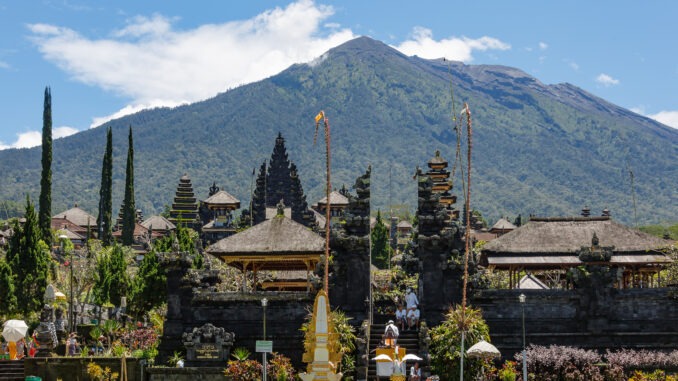
Photo by CEphoto, Uwe Aranas or alternatively © CEphoto, Uwe Aranas, Besakih Bali Indonesia Pura-Besakih-03, CC BY-SA 3.0
pura Besakih
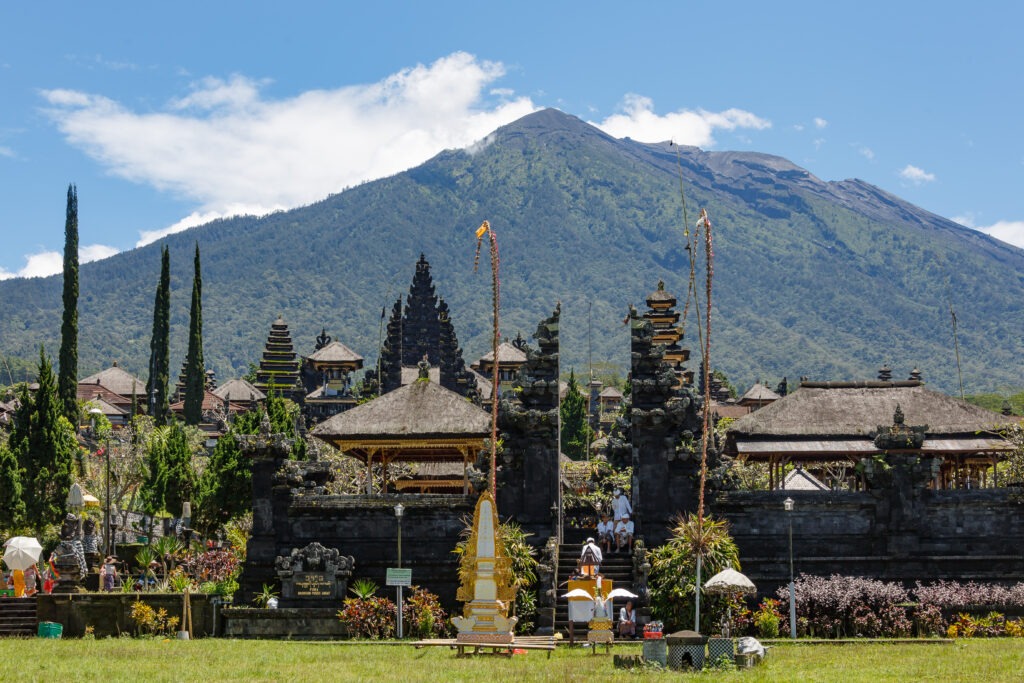
Photo by CEphoto, Uwe Aranas or alternatively © CEphoto, Uwe Aranas, Besakih Bali Indonesia Pura-Besakih-03, CC BY-SA 3.0

In the past, the Indonesian island of Bali has become more and more attractive as a vacation destination for many people in the world. The pleasant temperatures, as well as the (for us Central Europeans) exceptional nature are among the main reasons why the island has become extremely popular for any number of tourists.

Besides special animals and plants, the island visitors are offered other natural attractions, such as the impressive volcano called„Gunung Agung„. More interesting information about this natural attraction can be found in this article.

General info & history of „Gunung Agung

Indonesia generally has several quite high volcanoes. However, Gunung Agung is one of the five highest volcanoes in the entire country, and with a total height of 3,142 meters, represents the highest mountain in Bali. The locals say that Gunung Agung is for them the holiest of all mountains, and also the center of the world. The majority of all religious Balinese align their lives with the volcano. In addition, the mountain is said to be the home of their gods, on the one hand, and the home of the spirits of their ancestors, on the other.

According to a legend, the volcano was created by the hand of the Hindu god„Pasupati„, in which the god split the mountain called„Meru“ (in their eyes the spiritual center of the universe), and then created the volcano Gunung Agung from a mere splinter. This is also the reason why the mountain is considered the center of the world for many religious Balinese.

On the southwestern slope at an altitude of 900 meters there is also a Hindu temple called„Pura Besakih„. It is said of this temple that the ancestors of the locals are worshipped there just like the gods. In addition, the mountain has several shrines and altars, which may not be entered by strangers.

Within religious ceremonies, the volcano is regularly climbed by many believers. Meanwhile, palm leaves carried along ensure that holy water is collected. Towards the end of such ceremonies, pilgrims are then sprinkled with this holy water.

Recent volcanic eruptions
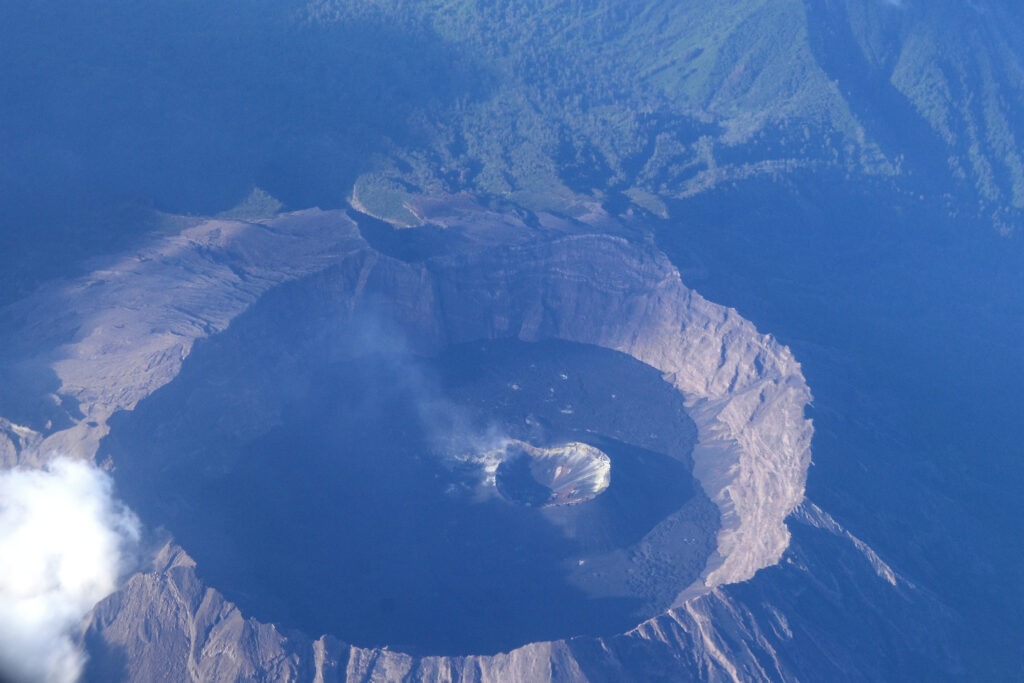
Gunung Agung
Iqro Rinaldi, Kawah Gunung Agung, CC BY-SA 4.0

As impressive as volcanoes may seem from a safe distance, they can unfortunately often be dangerous for people living nearby. And Gunung Agung is also one of the active volcanoes, so potentially dangerous eruptions can never really be ruled out.

In the not so distant past, Gunung Agung has erupted several times, spewing out a lot of lava, rock and ash, so that whole villages had to be evacuated, and exclusion zones had to be set up around the mountain. Sometimes there were also noticeable restrictions on air traffic, as the ash clouds emitted by the volcano were simply far too large and dense.

A few years ago, towards the end of November 2017, numerous volcanologists had warned of a very strong eruption, which fortunately did not happen. However, extremely large ash clouds had nevertheless ensured that during this time all flights to and from Bali had to be canceled.

Then, the following year(2018), there were multiple outbreaks at different times of the year, forcing air travel to be restricted again that year (and this time, multiple times). Several outbreaks then occurred again in 2019, prompting another round of flight cancellations on May 24, 2019.

So, before traveling to Bali, it is definitely advisable to inquire about the current volcanic activities of Gunung Agung. There are various websites for this, including the website of the German Foreign Office.

The climb
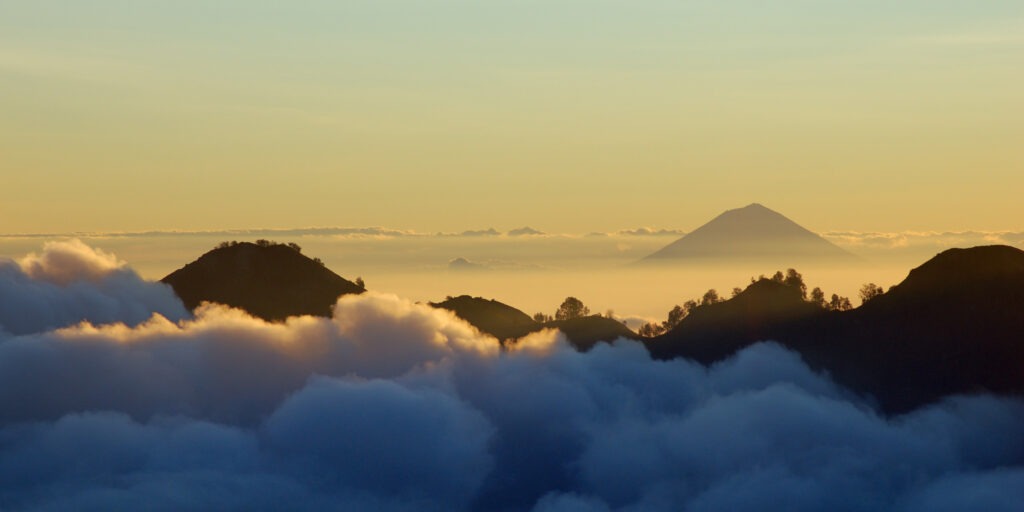
Bali Gunung Agung
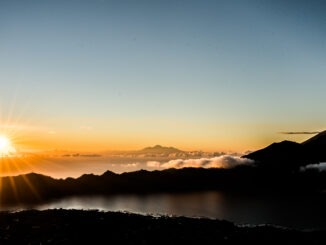
Rosino, Bali’s Gunung Agung seen at sunset from Gunung Rinjani, CC BY-SA 2.0

Especially for the inexperienced, the ascent of the mountain often turns out to be relatively difficult. Especially at the beginning of the ascent, many beginners do not cope with the high humidity of the jungle, or have difficulty with the sometimes uneven paths. Since the ascent is also quite steep, this can be quite energy-sapping for many. As a tourist, you should always take at least one local guide with you when you climb, as they will know exactly which sacred sites are off limits, for example.

In addition, the guides know their way around the mountain even in the dark, so it’s hard to lose your bearings at night on Gunung Agung. From the multitude of possible paths that lead up the mountain, two paths have emerged over time that are particularly popular for the ascent.

The Southwest Route

This trail starts from the Hindu temple Pura Besakih and takes about six to eight hours. The goal is the highest mountain peak. The last hour of the climb is considered particularly demanding on this route. Most of the time it is decided to start the tour on this route around 11 p.m., so that at the end a beautiful sunrise can be enjoyed in time on the mountain top.

The southern route

Not far from the village„Selat“ (at the temple „Pura Pasar Agung“) begins the southern route, which is considered the faster and easier of the two routes. The trail should only take a total of four hours, but it ends about 100 meters below the summit. The path starts in a forest section, and then leads over stony paths, as well as over petrified lava up the mountain. Climbing passages are also part of the southern route.

The descent

Regardless of which of the two paths you choose – the descent will be quite strenuous either way, as your own body weight must always be well supported with targeted steps. As soon as the jungle section begins, the path also tends to become relatively slippery. In any case, it is advisable to be as careful on the descent as on the ascent.

Other attractions in the vicinity

Gunung Agung is undoubtedly one of the sights that make a trip to the Indonesian island of Bali worthwhile. However, this does not mean at all that during a stay in this area you have to limit yourself only to the volcano. In fact, there are many other attractions nearby that can be reached quite easily from the vicinity of the volcano.

For example, if you plan a tour to the mountain, you can also combine this tour with a visit to the water palace„Tirta Gangga„, or make a side trip to the Bali Aga village„Tenganan„. A visit to the temple „Pura Besakih“, which is located directly on the slope, can also be wonderfully accommodated in a day trip to the volcano – however, you should allow at least two hours for the visit to the temple.
Related websites

Gunung Agung

Photo by CEphoto, Uwe Aranas or alternatively © CEphoto, Uwe Aranas, Besakih Bali Indonesia Pura-Besakih-03, CC BY-SA 3.0
pura Besakih
Foto de CEphoto, Uwe Aranas o bien © CEphoto, Uwe Aranas, Besakih Bali Indonesia Pura-Besakih-03, CC BY-SA 3.0

La isla indonesia de Bali se ha vuelto cada vez más atractiva como destino de vacaciones para muchas personas de todo el mundo. Las agradables temperaturas, así como la extraordinaria naturaleza (para nosotros, los centroeuropeos), son algunas de las principales razones por las que la isla se ha hecho muy popular para muchos turistas.

Además de animales y plantas especiales, a los visitantes de la isla se les ofrecen otros atractivos naturales, como el impresionante volcán llamado„Gunung Agung„. Puede encontrar más información sobre esta atracción natural en este artículo.

Información general e historia del „Gunung Agung

En general, Indonesia tiene varios volcanes bastante altos. Sin embargo, el Gunung Agung es uno de los cinco volcanes más altos de todo el país y, con una altura total de 3.142 metros, es la montaña más alta de Bali. Los lugareños dicen que el Gunung Agung es para ellos la más sagrada de las montañas, y también el centro del mundo. La mayoría de los balineses religiosos alinean su vida con el volcán. Además, se dice que la montaña es el hogar de sus dioses, por un lado, y de los espíritus de sus antepasados, por otro.

Según la leyenda, el volcán fue creado por la mano del dios hindú„Pasupati„, en la que el dios partió la montaña llamada„Meru“ (a sus ojos el centro espiritual del universo), y luego creó el volcán Gunung Agung a partir de una simple astilla. Esta es también la razón por la que la montaña se considera el centro del mundo para muchos balineses religiosos.

En la ladera suroeste, a una altura de 900 metros, también hay un templo hindú llamado„Pura Besakih„. Se dice de este templo que los antepasados de los lugareños son venerados allí como los dioses. Además, la montaña cuenta con varios santuarios y altares, a los que, sin embargo, no pueden acceder los forasteros.

Dentro de las ceremonias religiosas, muchos creyentes suben regularmente al volcán. Mientras tanto, las hojas de palma que se llevan a lo largo aseguran la recogida de agua bendita. Hacia el final de estas ceremonias, los peregrinos son rociados con esta agua bendita.

Erupciones volcánicas recientes

Gunung Agung
Iqro Rinaldi, Kawah Gunung Agung, CC BY-SA 4.0

Por muy impresionantes que parezcan los volcanes desde una distancia segura, desgraciadamente a menudo pueden ser peligrosos para las personas que viven cerca. Y el Gunung Agung es también uno de los volcanes activos, por lo que nunca se pueden descartar las erupciones potencialmente peligrosas.

En un pasado no muy lejano, el Gunung Agung entró en erupción varias veces, arrojando gran cantidad de lava, roca y ceniza, por lo que hubo que evacuar pueblos enteros y establecer zonas de exclusión alrededor de la montaña. En ocasiones también se produjeron notables restricciones al tráfico aéreo porque las nubes de ceniza emitidas por el volcán eran simplemente demasiado grandes y densas.

Hace unos años, hacia finales de noviembre de 2017, numerosos vulcanólogos habían advertido de una erupción muy fuerte, que afortunadamente no se produjo. Sin embargo, las nubes de ceniza extremadamente grandes hicieron que todos los vuelos hacia y desde Bali tuvieran que ser cancelados durante este tiempo.

Al año siguiente(2018), se produjeron entonces varios brotes en distintas épocas del año, lo que obligó a restringir de nuevo el tráfico aéreo ese año (y esta vez varias veces). A continuación, se volvieron a producir varios brotes en 2019, lo que provocó otra ronda de cancelaciones de vuelos el 24 de mayo de 2019.

Por ello, antes de viajar a Bali, es recomendable informarse sobre la actividad volcánica actual del Gunung Agung. Existen varios sitios web para ello, entre ellos el del Ministerio de Asuntos Exteriores alemán.

El ascenso

Bali Gunung Agung
Rosino, Gunung Agung de Bali visto al atardecer desde Gunung Rinjani, CC BY-SA 2.0

Especialmente para los inexpertos, la subida a la montaña suele ser relativamente difícil. Especialmente al principio de la subida, muchos principiantes no pueden soportar la alta humedad de la selva, o tienen dificultades con los senderos a veces irregulares. Dado que la subida es también bastante empinada, puede resultar bastante agotadora para muchos. Como turista, siempre debe llevar al menos un guía local cuando suba, ya que ellos sabrán exactamente qué lugares sagrados están prohibidos, por ejemplo.

Además, los guías conocen su camino por la montaña en la oscuridad, por lo que es difícil perder la orientación en el Gunung Agung por la noche. De la multitud de caminos posibles que suben a la montaña, con el tiempo han surgido dos senderos especialmente populares para la subida.

La ruta del suroeste

Este sendero parte del templo hindú Pura Besakih y dura entre seis y ocho horas. El destino es el pico más alto de la montaña. La última hora de la subida se considera especialmente exigente en esta ruta. Por lo general, se decide iniciar el recorrido por esta ruta alrededor de las 11 de la noche, para poder disfrutar con tiempo de un hermoso amanecer en la cima de la montaña al final.

La ruta del sur

No muy lejos del pueblo de„Selat“ (en el templo „Pura Pasar Agung“) comienza la ruta sur, que se considera la más rápida y fácil de las dos. Se supone que el sendero sólo dura cuatro horas en total, pero termina a unos 100 metros por debajo de la cumbre. El sendero comienza en un tramo de bosque y luego asciende por la montaña por senderos pedregosos y lava petrificada. Los pasos de escalada también forman parte de la ruta sur.

El descenso

Independientemente de cuál de los dos caminos elija, el descenso será bastante extenuante en cualquiera de los dos casos, ya que el propio peso del cuerpo debe estar siempre bien soportado con pasos dirigidos. En cuanto comienza la sección de la selva, el camino también tiende a volverse relativamente resbaladizo. En cualquier caso, es aconsejable tener tanto cuidado en el descenso como en el ascenso.

Otros lugares de interés en los alrededores

El Gunung Agung es, sin duda, uno de los monumentos que hacen que merezca la pena un viaje a la isla indonesia de Bali. Sin embargo, esto no significa que uno tenga que limitarse al volcán durante su estancia en esta zona. De hecho, hay muchos otros lugares de interés cercanos a los que se puede llegar con bastante facilidad desde las inmediaciones del volcán.

Aquellos que planeen una excursión a la montaña, por ejemplo, también pueden combinarla con una visita al palacio del agua„Tirta Gangga„, o desviarse a la aldea Bali Aga„Tenganan„. La visita al templo „Pura Besakih“, que se encuentra directamente en la ladera, también puede integrarse maravillosamente en una excursión de un día al volcán; sin embargo, debe prever al menos dos horas para la visita al templo.

Sitios web relacionados